

Flavors of Magic
Fantasy vs. Magical Realism vs. Speculative Twists

Hello, Protagonists!
Welcome to another entry in Author Diaries—where we explore a behind-the-scenes topic of the book world. In this post, we’ll take a deep dive and explore the distinction between genres that contain magic.
As always, thank you for being here, not just as readers, but as fellow story-lovers and co-dreamers of this beautiful, bookish life.
xo, Joanna
Flavors of Magic
Fantasy vs. Magical Realism vs. Speculative Twists
I love a little magic in my books, and lucky for me, the supernatural has flourished across and between genres in the book world. But now, when I walk into the bookshop, I wonder what to order. One scoop of historical, a second scoop of magical realism, and a sprinkle of time travel?
Genre-bending books and the professionals who market them have created and overlapped categories such that I’m often unsure about what I’m getting. So, this essay is my attempt to understand some of the genres and subgenres with unreal elements.
Why even care about categories?
Sometimes when I talk about genres, writers and readers feel ruffled and say something like - “Genres are limiting,” or “Categories are arbitrary–who cares?!” And I see the truth in these sentiments. As a writer, I’ve felt both penned in by a genre and also how easily I can write straight through these imaginary lines.
However, as a reader, I’ve often felt frustrated when the category was misleading, such as being told something was magical realism and then discovering it was a cozy contemporary fantasy about witches, or picking something from a contemporary romance table and finding out halfway through that the protagonist is a vampire.
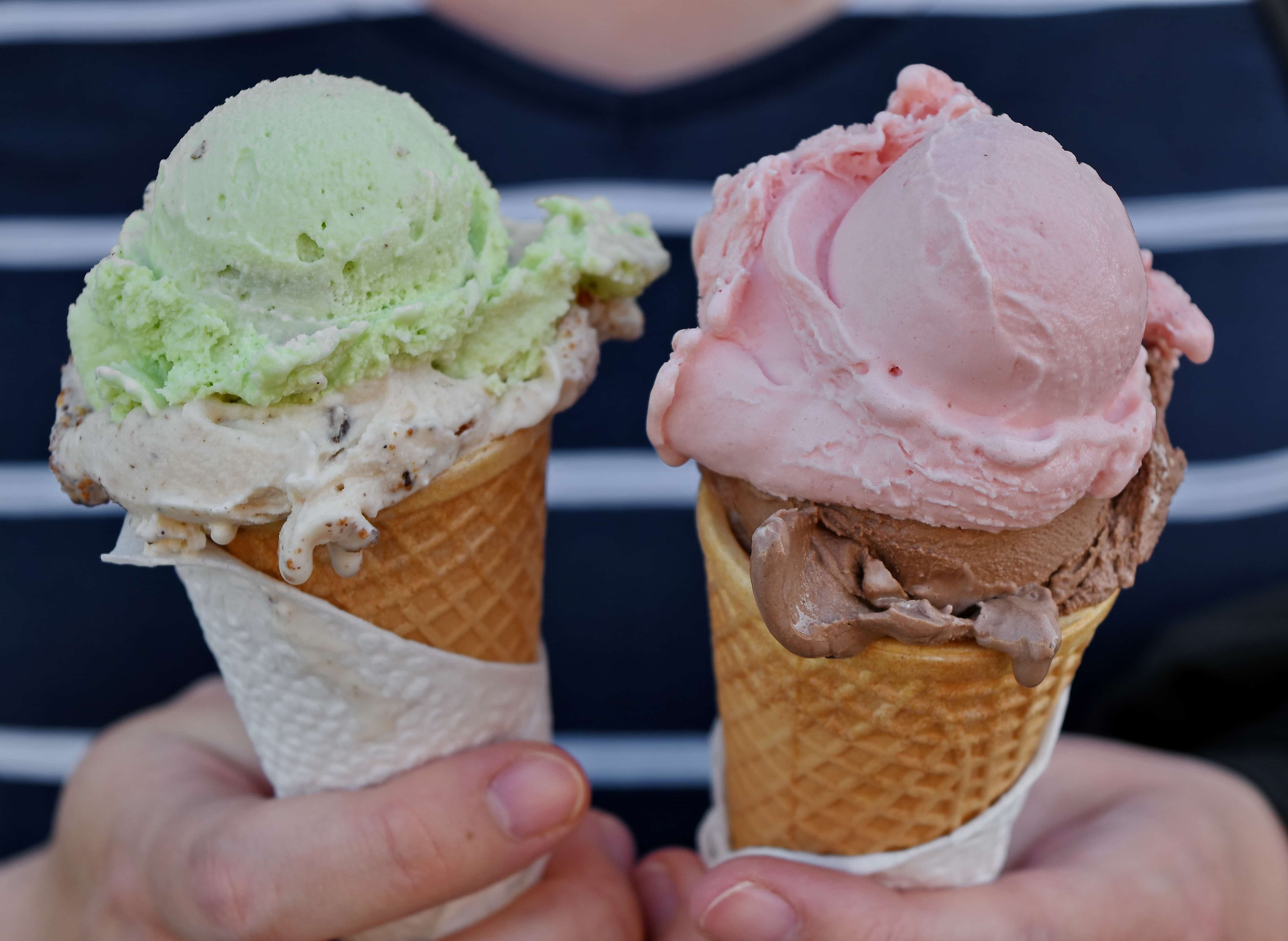
It felt like I ordered strawberry and got chocolate chip cookie dough. Now, I like both flavors, but the surprise of biting into an unexpected genre mid-cone threw me out of the reading experience. Ultimately, I think these categories help set readers’ expectations.
As I bend genres in my own writing and pitch my work to readers, I strive to be clear and helpful. So, I’m setting out to understand the difference between fantasy, magical realism, speculative fiction, and several twists of these flavors.
Speculative and Fantasy and Magical Realism, Oh My!
I often find these three terms used interchangeably, so I researched how experts distinguish their differences.
Speculative
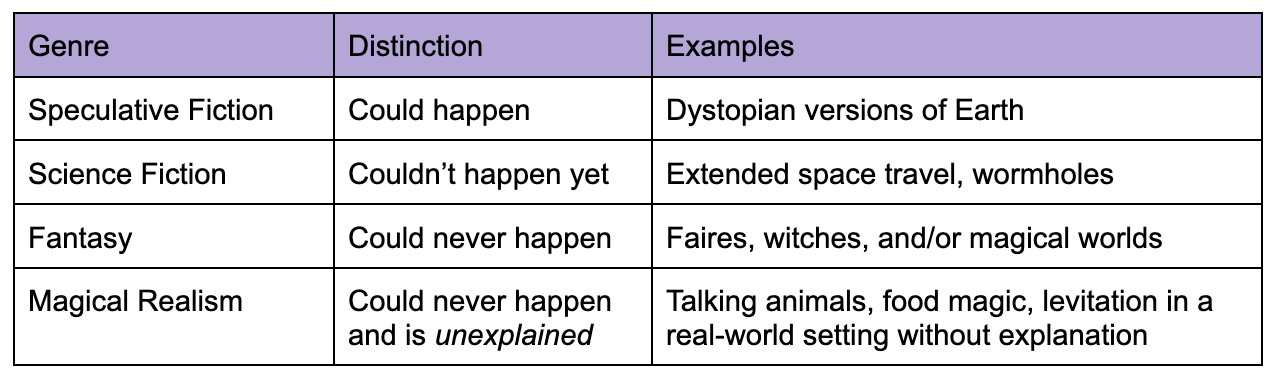
Speculative fiction includes any story that departs from strict realism by exploring scenarios that could not possibly happen in our current world. In reading about the meaning of speculative, I discovered some fun drama between two titans in the sci-fi fantasy world: Margaret Atwood and Ursula K. Le Guin.
Atwood offers this definition for speculative fiction:
“For me, the science fiction label belongs on books with things in them that we can’t yet do, such as going through a wormhole in space to another universe; and speculative fiction means a work that employs the means already to hand, such as DNA identification and credit cards, and that takes place on Planet Earth. But the terms are fluid. Some use speculative fiction as an umbrella covering science fiction and all its hyphenated forms - science fiction fantasy, and so forth - and others choose the reverse.”
It’s reported that Le Guin questioned whether Atwood’s distinction was made to distance her novels from the less esteemed genre roots of sci-fi and signal literary elevation. In the end, Atwood and Le Guin agreed on the definitions and admire one another to this day. Reading about this schism, I took away the importance of respecting all forms of fiction and the caution of conflating literary with superiority.
Fantasy
Atwood and Le Guin readily agreed that the fantasy genre features supernatural elements that could never exist in the real world. The flavors within fantasy are as prolific as the creatures found on its pages, with a major distinction between high fantasy (epic, magic-filled quests in other worlds) and low/contemporary/urban fantasy (blends magic into modern life/this world). Then there are so many subgenres: dark fantasy, historical fantasy, steampunk fantasy, cozy fantasy, romantasy, portal fantasy, and more, which are further defined by setting, tone, and magical rules. Magical realism is sometimes listed as a fantasy subgenre, but more often it’s classified as its own separate animal.
Magical Realism
Magical realism is one of those genres that many people struggle to pin down, but this seems to be intrinsic to its very nature. Magical realism is the dream genre of fiction. Is it real? Is it a dream? It’s slippery like a fish that laughs at you as it dissolves into a cloud.
Magical realism in literature arose soon after World War II, with Jorge Luis Borges and Gabriel Garcia Marquez in South America, Gunter Grass in Germany, and Italo Calvino and Umberto Eco in Italy. In magical realism, “the frame or surface of the work may be conventionally realistic, but contrasting elements –such as the supernatural, myth, dream, fantasy–invade the realism and change the whole basis of art.”
Reissenweber at Gotham Writers provides the distinction: “While magical realism situates readers in a predominantly realistic world, fantasy takes place in an unreal world with unreal characters.” Woodson at Writer’s Digest goes on to differentiate, stating magical realism has an intentional lack of explanation about why the magic exists, less of a traditional plot structure, and uses magical elements as more of a continuous metaphor…In fact, magical realism is a closer relative to literary fiction than fantasy—which helps in identifying it in the books we read.”
For me, the simplest defining feature of magical realism is that the magical elements are not explained or acknowledged. If the characters discuss the magic at play, it’s fantasy, whereas if the magical elements unfold without comment, it’s magical realism. In my own reading and writing experience, I could even interpret the magical elements in MR as figurative language or occurring within the protagonist’s imagination. I enjoy wondering, did it really happen?
This and That
I posit that the post-2010 boom in the fantasy market contributed to the blurring of these categories. I imagine that marketers called light contemporary fantasy “magical realism” before this category caught on as a legitimate subgenre all its own. Or since magical realism can be interpreted as literary writing with fantasy elements, maybe some used the term to “elevate” work beyond the fantasy genre, similar to the Atwood/Le Guin kurfuffle. But now that adult fantasy has gained mass appeal, maybe magical realism can return to its more unique self.
In the spirit of blending and bending, I asked myself: could fantasy and magical realism be combined? While I am in no position to police these categories, only discuss them, my opinion is that one disrupts the intention of the other. The technique of magical realism creates the question: Is this even real? The power of leaving unreal things unexplained is that you allow the reader to explain it themselves. That’s the delight of magical realism for me. So if fantasy is added by explaining the magic with backstory, establishing unreal character types, or building a new world, the element of magical realism I like best–the metaphoric mystery–breaks down. I love fantasy as fantasy and magical realism as magical realism.
Flavor Descriptions
I found this distinction helpful and added magical realism to the rubric:
Genre vs. Twist
In this discussion of magical flavors, I think it’s important to talk about twists. Sometimes novels are firmly planted in one genre (i.e. romance or mystery), and then have a twist or elements of another genre (i.e. fantasy or sci-fi). How delicious! So, I wanted to know: what makes something a genre vs. a twist?
In deciding the main genre of a novel, the time period, writing style, setting, and target audience all matter, but the trickiest question, in my opinion, is: What is the story’s main plot-line and/or central question? For example, in determining whether a novel is romance with fantasy or fantasy with romance, we ask: Is the central question whether the love interests will end up together, or will the protagonist overcome the supernatural odds to survive/succeed? Now both questions can be posed, but the one that feels most central determines the primary genre.
Compared to a genre, a twist is a subtle or isolated element within a novel. It often indicates a “what if” plot device in the story rather than the overarching basis of the narrative. Speculative twists can be added to any genre: fiction, romance, thriller, mystery, etc. For example, in a romance, “what if” science can determine your soul mate (The Soulmate Equation by Christina Lauren). Or in a thriller, “what if” you saw your son commit murder and then restarted the day and had to figure out his trigger (Wrong Place Wrong Time by Gillian Flynn).
The speculative twist informs the premise and impacts the plot but does not change the foundational realism. In addition, the twist does not usurp the central question of the novel. The Soulmate Equation is not primarily about using DNA matchmaking, it’s still about the protagonists’ relationship - will they end up together?
Let’s Order a Few Off the Menu
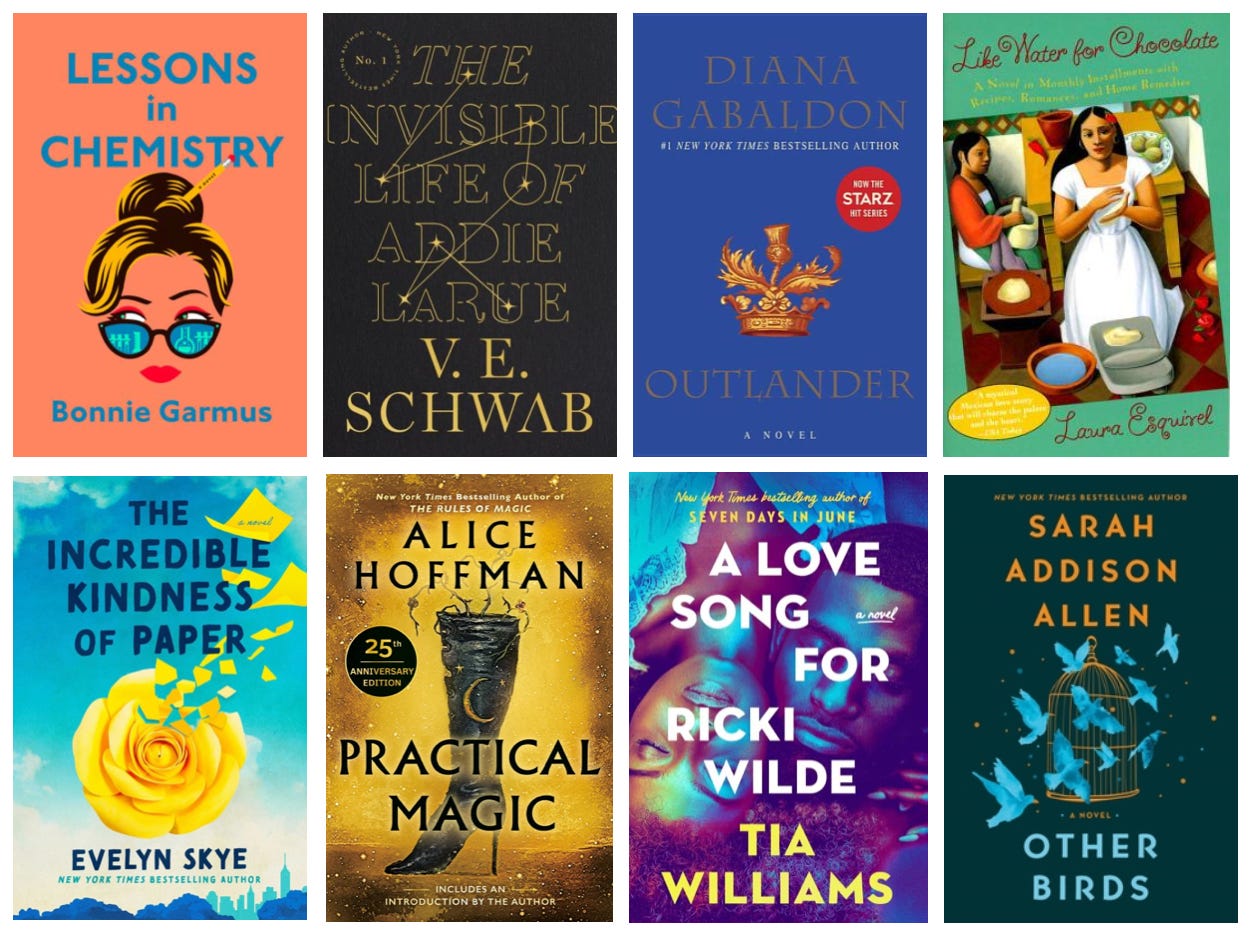
Enough with all these definitions, let’s apply them to some stories we know and love. To keep things simple, I set the audience to adult and then played with two time periods: historical and contemporary fiction.
Historical
Lessons in Chemistry by Bonnie Gramis - Historical Fiction with Magical Realism
In the 1960s, Elizabeth Zott, a brilliant chemist forced out of research, reluctantly becomes the beloved host of a TV cooking show. Several chapters are written from the perspective of Zott’s dog, Six Thirty, adding a twist of the unreal to the novel. Since this magical element is a real being and never acknowledged by the characters, but is layered into the story to depict the protagonist’s emotional life, I consider this an element of magical realism.
The Invisible Life of Addie LaRue by VE Swab - Historical Fantasy
In 1714, Addie LaRue makes a bargain with a dark, god-like entity for immortality but is cursed to be forgotten by everyone she meets, leading to a centuries-long, invisible existence. These are clearly unreal characters, putting this into the fantasy genre. In addition, these elements provide more than a twist but also the driving question of the novel. Will Addie break free of this fantastical bargain and finally be remembered?
Outlander by Diana Gabaldon - Historical Romance with a speculative twist
Claire Beauchamp, a WWII nurse, is propelled through time by an ancient stone circle. While surviving 18th century Scotland, she falls in love with clansman, James Fraser. The central question shifts from will she survive or return home, to will the lovers end up together, making this primarily a historical romance, while the speculative twist of time travel serves the love story. In addition, the magic of time travel is discussed and explored by the characters, making this a fantasy element rather than magical realism.
Like Water for Chocolate by Laura Esquivel - Magical Realism
This one is my absolute favorite. Tita De La Garza, a young woman in revolutionary-era Mexico, is forbidden by tradition from marrying her love, Pedro, because she must care for her mother. Tita expresses her intense emotions through cooking, which affects those who eat her food–an unreal, but also unexplained phenomenon in the novel. The magic imbues every chapter to express the restriction of desire and forbidden love, delivering the central idea of whether passion can triumph over oppression and serving as a classic example of magical realism as a genre.
Contemporary
The Incredible Kindness of Paper by Evelyn Skye - Contemporary Fiction with Magical Realism
Chloe Hanako Quinn, a down-on-her-luck guidance counselor, leaves encouraging messages hidden in origami roses around the NYC. These roses have an unexplained magical ability to find people in need, leading her to a second chance with a childhood friend. The roses are a subtle, unexplained element that serves the realism rather than disrupting it to support the central theme of kindness, making this contemporary fiction with a magical realism element or twist.
Practical Magic by Alice Hoffman - Contemporary Fantasy
Sally and Gillian Owens, raised by eccentric aunts in a town that shuns them as witches, are cursed in love such that any man they love dies. The sisters must face their curse and embrace their magic. As witches, these characters are unreal beings and seek to understand the magic in the novel as part of the main plotline. Using the rubric above, the novel fits into the contemporary fantasy genre despite it being often labeled as magical realism.
A Love Song for Ricki Wilde by Tia Williams - Contemporary Romance with a speculative twist
Ricki Wilde moves to NYC to open a florist shop in Harlem and falls for Ezra, a mysterious musician cursed by a scorned lover to live forever and lose his true love. The central question is whether the lovers will end up together, indicating the primary genre of a romance. And Ezra’s curse has an extensive backstory, and the lovers try to undo it, making the magical element a speculative twist.
Other Birds by Sarah Addison Allen - Magical Realism
Zoey Hennessey moves to Mallow Island, South Carolina, to claim her deceased mother’s apartment in a building filled with quirky neighbors, ghosts, and mysterious turquoise birds. These ghosts and spirits are unexplained, integral parts of the character’s transformation that serve to enhance the realism of confronting fears and releasing past stories, giving us a contemporary example of magical realism.
Yum!
Each of these categories and everything in between lets us revel in our imaginations to see ourselves and our world differently. Exploring distinctions between these traditions helps me understand the craft, clearly set my readers’ expectations, and supports me in creating just the flavor of ice cream I crave. Now, what’s your favorite flavor?
Share your thoughts on this menu of magic in the comments.
🧚♂️ Do you prefer fantasy or magical realism?
🧐 Do you agree with Atwood or Le Guin?
🍦 What is your favorite ice cream flavor?
I love your rubric/chart of magical flavor descriptions. I'll take one scoop of each please! :)
Love this article! A helpful article in the muddy waters of genre. Arrived in my inbox at the perfect time.