

Writing a Recipe for Transformation
In Our Novels and Our Lives

Hello Protagonists,
Welcome back to Letters from the Creative Life. These occasional essays explore the quieter corners of being a creative: small reflections on art, ambition, and the tender balancing act of building a meaningful life in a noisy world. Think of them as letters from our lives to yours.
In this post you’ll find:
📚 What’s Filling My Creative Well—a book and an article that are lighting me up
✨Writing a Recipe for Transformation for Our Characters and Ourselves
As always, thank you for being here, not just as readers, but as fellow story-lovers and co-dreamers of this beautiful, bookish life.
💕, Joanna
📚 What’s Filling My Creative Well
Current book: Yesteryear by Caro Claire Burke — This story is about a tradwife influencer who builds a five-million-follower Instagram empire by curating an illusion of domestic perfection. Her modern life shatters when she is inexplicably transported to 1855 and forced to live in the harsh pioneer world she had romanticized online.
This is our July Book Club Pick. I haven’t heard this many emotional reactions to a book since Miranda July’s All Fours, so obviously, we need to all talk about it.
Reminder: Our Book Club meeting is on Sunday, July 26, 2026 at 8pm ET / 5pm PT. Discussion Qs and more info HERE.
Current article: 10 uses for a pocket notebook to keep you off your phone by Amy Catriona — I’ve been inspired to use my journal in new ways. To let my mind explore in small spurts on paper instead of scrolling. My particular favorites are capturing overheard conversations and favorite lists. I can only imagine how these might find their way into my fiction.
Writing a Recipe for Transformation

I am a writer and a coach, and the area where these two professions overlap happens to be at the very center of both–transformation.
As writers, we take our protagonists and profoundly change them. They often start at the effect of their life and the world around them. Then, after facing challenge after challenge, they begin to understand themselves, take responsibility, and make active choices that lead them to their ultimate transformation.
And when I coach real people, I help them do the same. I’ve learned to call this shift going from a “to me” to a “by me” way of being, or from a victim to a creator stance in the world.
As storytellers, we get this shift. It underlies the overarching story arc–going from a wallflower to a confident kid, from a rejected heir to the king, from a midlife crisis to a new calling. But how is this accomplished page by page for our characters and day by day for ourselves? From my experience, these big transformations are made up of many small shifts from “to me” to “by me” in the muddy middle of novels and life.
In fact, we can use the same tool to figure out our character’s transformation that we use to help shift our own lives.
“To Me” Way of Being
With a “to me“ perspective on the world, we adopt a victim stance to the circumstances around and within us. A “to me” mindset is expressed as: I can’t, I should, I have to, They won’t let me… We believe that the causes of our well-being are outside of our control, which in turn is horrible for our well-being.
Some “to me” outlooks I’ve had to challenge as a creator include: “No one wants to buy my art.” “I don’t have enough energy at the end of the day to write.” “The world is broken. What’s the point in making art anyway?”
There are real obstacles in the external world that make creating a fulfilling, creative life difficult. These circumstances deserve empathy, and believing that we have no agency to make our lives better creates even more suffering. We cede the role of protagonist in our own lives.
Just like the main characters in our novels, we can’t magically make the world just, fair, or easy. And if a character complained about their circumstances or blamed someone else for the entirety of 300 pages, we wouldn’t read the book. Our novels help us see that the challenges around us are what make us.
“By Me” Way of Being
With a “by me“ perspective on the world, we adopt a creator stance to our circumstances. Instead of believing that the cause of our experience lies outside of us, we come to see that we are the cause of our experience. We stop blaming and start taking responsibility.
And going one step further, looking at the problems and asking–What can I learn from this? How is this unfolding for me to grow? We don’t ignore or skip over hard things, but choose to see them as a call for our transformation.
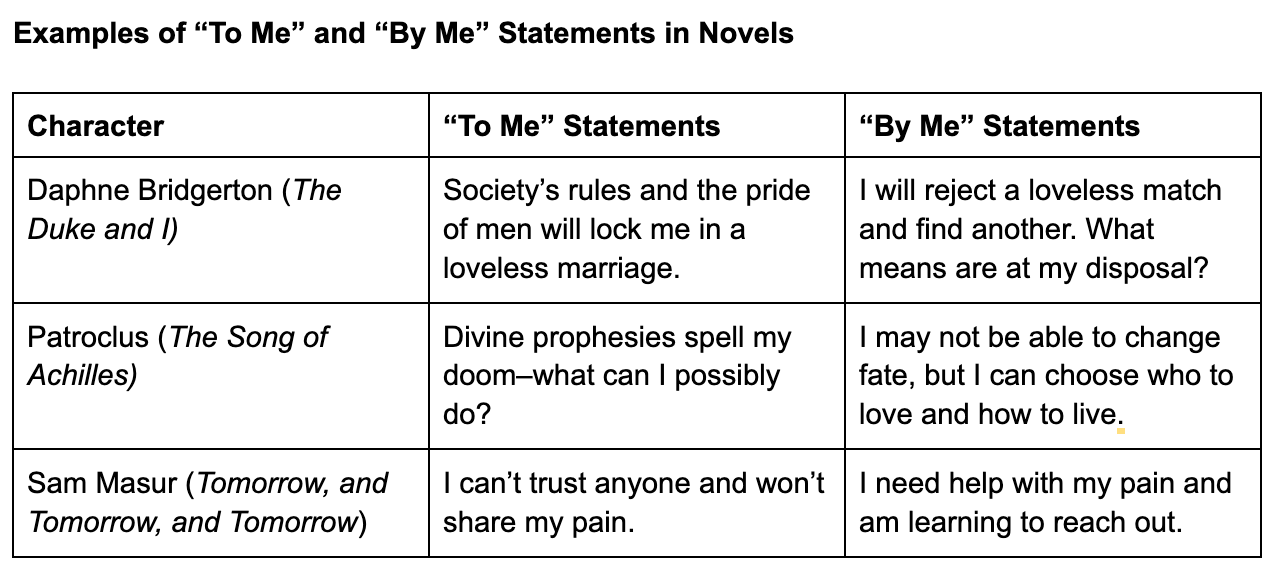
We feel this on the page–the character waking up to their own agency–and it’s thrilling. And we can give ourselves the same gift. So, how do we shift?
Write a Recipe
Finding an extremely handsome demigod or duke isn’t the only way to shift. Sometimes, simply gaining awareness of our “to me” state can help us make different choices.
One of the tools I learned from my mentor is called “Writing a Recipe.” When I’m stuck in a “to me” way of being, instead of trying to escape it, I lean in and explore it. I begin by fully expressing my “to me” mindset. I flail and complain and growl about all that’s happening “to me” — what’s terrible about my situation, and who’s to blame. I let it be messy because to shift, I need to fully understand how I’m stuck.
The next part can be a little counterintuitive, but stay with me. I write a recipe for how someone else can find themselves in the same terrible predicament as me. I describe the choices and beliefs that led me to the specific problem I face. Note: this is not a recipe for the solution; we’ll come to that later.
Let’s play with one of my recent “to me” stories: “No one wants to read my 1940s women’s fiction novel with cozy romance elements.” Now, let me complain: “I wrote what I love, and it’s not what the market wants. My work falls into a gap between genres that doesn’t have enough comps to support it. Women’s fiction people won’t like the cozy romance, and the cozy romance readers don’t want historical unless it involves dukes or demigods. Grrr, waaaah, pout!”
Now, let me write a recipe so that if someone followed it step-by-step, they too would end up in my situation.
Ingredients: fear of rejection, pride, self-doubt, passion
Start by writing the story that moves you. Do some scant market research and be sure to ignore any red flags.
Once you’ve polished the novel, share it with a few beta-readers, then discount their positive feedback and imagine crushing criticisms instead.
Don’t you dare share your book with more people, even when some beg you to read it, out of fear that they won’t like it. Oh, and don’t acknowledge this fear – that would be pathetic.
Push aside your deeper knowing that all art is sacred and your words matter. Give that advice to others, but struggle to accept it yourself.
When I put all that down, I saw clearly that this was not the artist I wanted to be. I saw how I was choosing to be a victim of my mindset and the market. The “by me” action steps also felt obvious. I saw how my fear of rejection held me back. I saw how my inner critic was trying to keep me safe while my deepest wisdom knew courage was required to share my work with the world. My shift from victim to creator was at my fingertips. In fact, I saw that this circumstance was exactly what I needed to grow into the empowered creator I want to be.
Okay, now let’s see how this tool can help with the elusive problem of weaving the character and plot development together through a novel.
You’ve got your character, they’ve got a problem, and now you need to transform them. First, free write their “to me” way of being at the beginning of the novel. Let them really tell you how everything is terrible. Then, write a recipe for how someone else can find themselves in the same terrible predicament as the protagonist.
What’s Daphne Bridgerton’s recipe for ending up in a loveless marriage? It might look something like this:
Ingredients: trust, naivety, devotion, accommodation
Prioritize your family’s reputation above your happiness.
Be flawless at meeting the patriarchal standards of elite society and internalize them while you’re at it.
Become an expert at suppressing your personal needs and curiosities, especially about anything untoward.
Blindly trust the men in your life to act in your best interest despite clear evidence of their pride and misjudgment.
A character’s “to me” recipe provides a specific list of ways the character hampers themselves, and a list of beliefs and actions that need to be challenged in their growth. Syncing a character’s “to me” recipe and “by me” actions connects plot and character in that magical way we yearn for.
For Daphne Bridgerton to stop making the recipe that creates a loveless marriage, she needs to risk her family’s reputation, to find and prioritize her own needs and curiosities, and to question the men’s intentions in her life over and over again. Julia Quinn and Shonda Rhimes thought of the most fun ways to do this.
Shift by Shift
I went to lunch with some writer friends last month. One of them, a literary fiction lover, was wading into the world of romance. We talked about the genre’s requirements, of which the most sacred is an HEA- Happily Ever After. My friend wondered, “What’s the point if you know how it ends?” Another friend answered, “The pleasure is in seeing how they get there.”
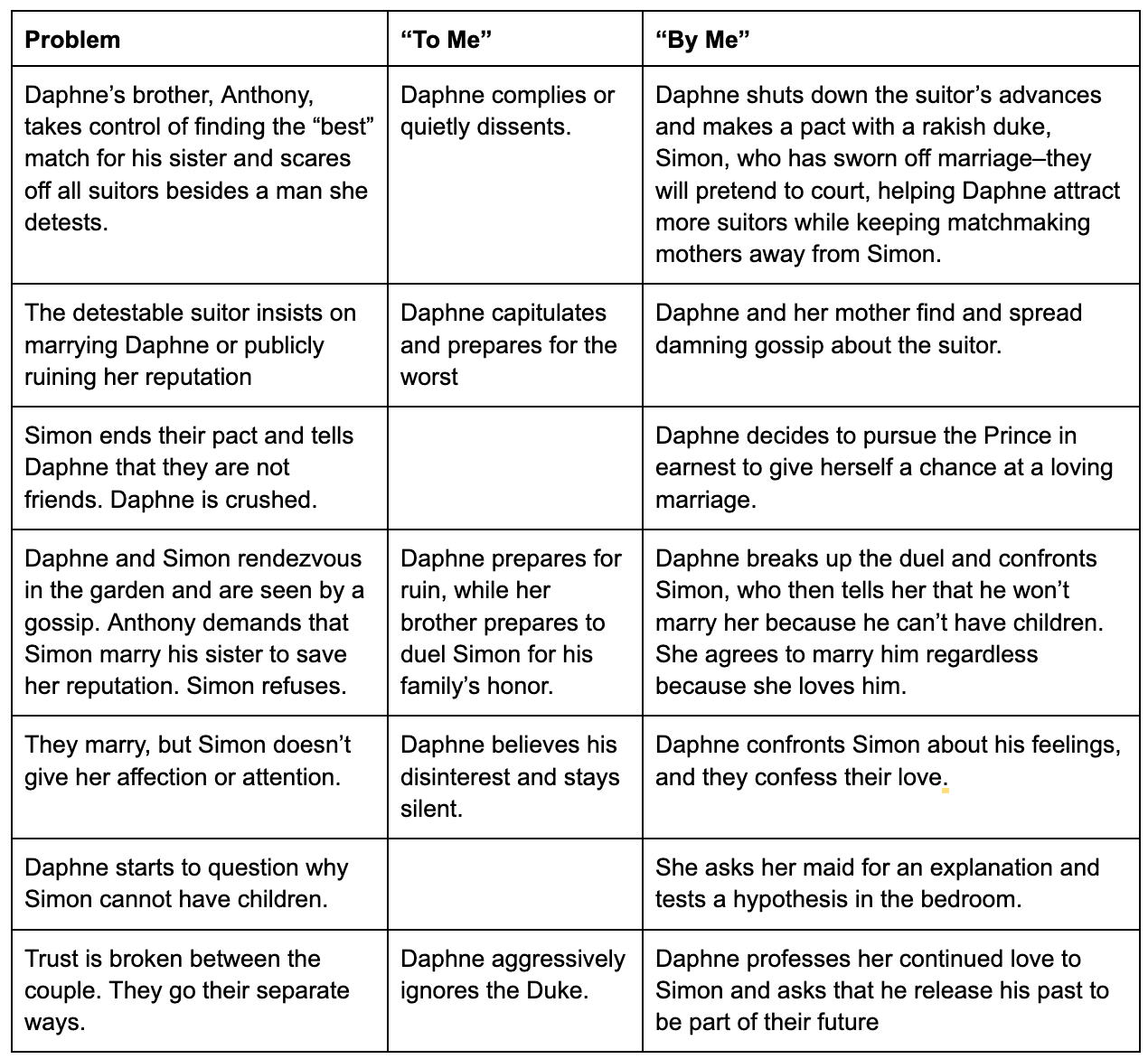
Even if the bigger shift is known, the journey is not. As writers, we walk characters from being a victim to the creator of their lives by presenting them with many problems in which they have the opportunity to practice shifting from “to me” to “by me” over the course of the novel, until the climax presents them with the largest challenge and allows them to step firmly into an empowered stance in their lives.
It doesn’t happen in one big epiphany, no, that novel would be short and the transformation unearned. We feel it in little shifts scene after scene. And our own transformations don’t happen all at once either. They happen through practice and repetition. This is not a one-and-done deal.
Here’s how Daphne toggles between “to me” and “by me” throughout the novel. You can see that each problem requires Daphne to challenge her recipe.
Let Your Protagonist Loose!
At Creative, Inspired, ALIVE, we begin each newsletter, “Hello Protagonist!” to remind ourselves that we get to create our own story. We all fall into a “to me” way of living, and we can transform ourselves just as beautifully and persistently as our characters. It’s not easy, but we’re artists, we know, in the words of Georgia O’Keeffe, “To create one’s own world takes courage.”
We all toggle between these ways of being, and the more practice we get in recognizing where we are and shifting to where we want to be, the more agency we have in our lives to create amazing art.
Share your thoughts in the comments.
⚡️What transformation are you writing for your characters?
🦹 How might you lean into a “by me” way of being this week?
🥣 What recipe have you tried lately?
Fantastic article! Thank you! I’ll be saving, printing and returning to this again and again. You so clearly captured the essence of transformation and illustrated how we can use it in our lives and stories. This is something I struggle with in life and on the page. I’m so thankful to have this guide!